Parakeet Connect
Self-directed AI learning for federal facilities. No staff required. No cost to BOP.
The Problem
77% of released individuals return to custody within five years (Bureau of Justice Statistics, 2018). The two strongest evidence-based interventions are education and family contact. But traditional classroom education is constrained by staffing, scheduling, and physical capacity. Most facilities cannot offer it at the scale the population requires.
Recidivism After Release
Bureau of Justice Statistics (2018) — 9-year longitudinal study of released prisoners
Parakeet Connect addresses this with AI. No teachers. No classrooms. No scheduling. Each participant gets personalized AI learning on demand through existing facility infrastructure.
How It Works
Two components, one platform. Education is the core; family communication runs alongside it.
AI Learning
Participants interact with an AI learning assistant for self-paced exploration: GED prep, vocational skills, career planning, legal research, reentry preparation. The AI adapts to each individual. RAND Corporation found correctional education reduces recidivism by 43%; every $1 invested saves $4–5 in reincarceration costs.
Family Communication
The same platform facilitates messaging with family and support networks. Minnesota DOC (2011) studied 16,420 released prisoners and found family contact reduces felony reconviction by 13% and parole violations by 25%.
How Participants Access It
Parakeet Connect currently operates through Corrlinks, the existing email system already deployed at all federal BOP facilities. No new hardware or software is required.
Participants send messages through Corrlinks as they would any other email. Parakeet receives the message, processes the AI interaction, and returns the response through the same channel. All messages pass through BOP's standard Corrlinks monitoring and review process, providing an additional layer of oversight beyond Parakeet's own AI safety filtering.
This means the program can be deployed immediately at any federal facility with Corrlinks access, with zero infrastructure changes.
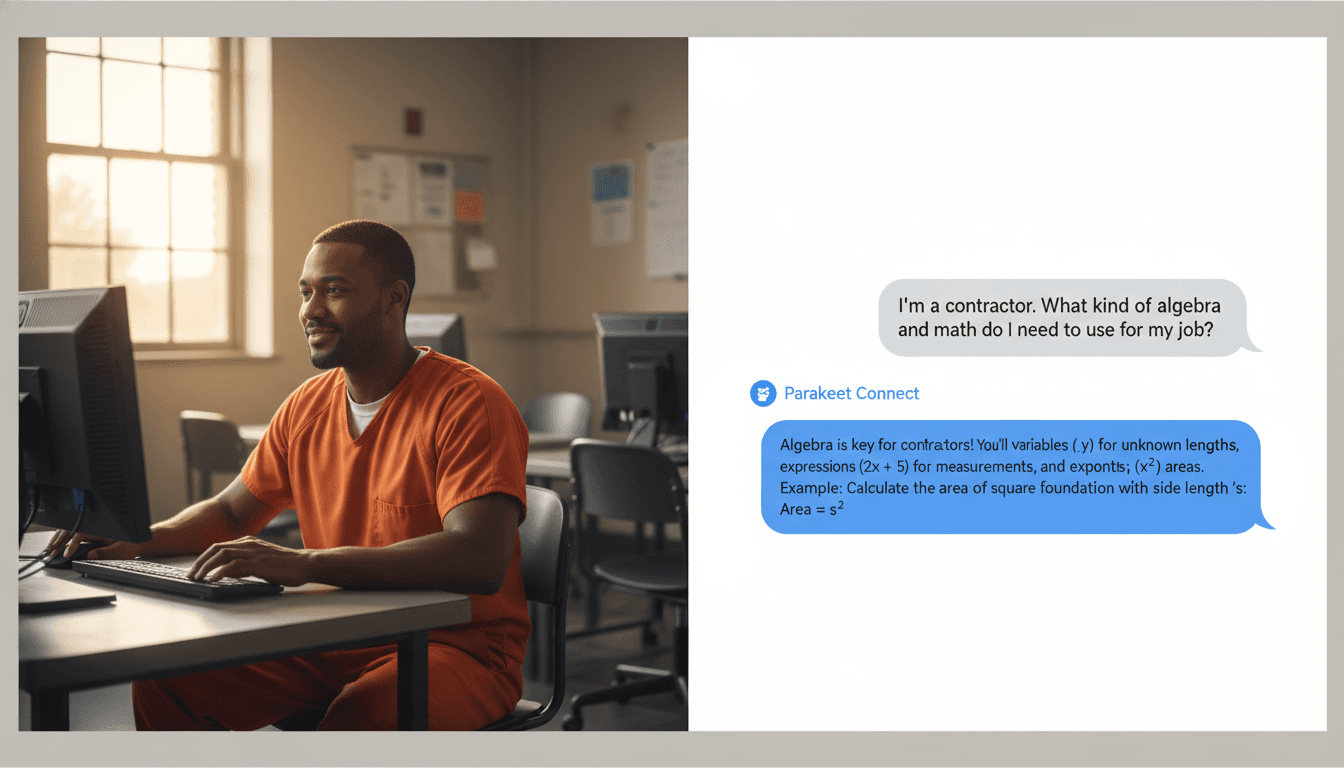
Real Questions from Participants
Actual questions from incarcerated users and the AI responses they received. Pulled from production data across federal facilities.
Participant
Questions shown verbatim. Responses excerpted for brevity.
How the AI Education Loop Works
When a participant asks a question, the AI first evaluates whether the query is appropriate to answer. If it passes, the AI generates a response, which is also reviewed before delivery. The AI adapts to each individual's level and builds on prior exchanges.
Self-Directed
Learning Loop
Any topic, any level
Personalized response
Builds on each answer
Query + response checked
Open-ended exploration
Participants ask anything: academic, vocational, personal, creative. The AI meets them at their level and builds on each exchange automatically.
Structured modules
The platform is being extended to support structured curricula aligned with BOP vocational programs: GED prep, reentry planning, financial literacy. Completion tracking integrates directly with facility case management systems.
Program Structure
12 weeks of structured participation with verifiable milestones, then ongoing access. Completion is tracked automatically through the Corrlinks message log — no BOP staff involvement required.
Weeks 1–2: Enrollment & Orientation
Participant sends enrollment message. AI introduces the platform, explains available topics, and identifies the participant's starting interests and goals.
Weeks 3–6: Active Learning
Participant engages with the AI on chosen topics. All exchanges logged automatically. No minimum frequency requirement — participation is self-directed.
Weeks 7–10: Applied Learning
Participant works on a practical output with AI assistance: resume, reentry plan, business concept, GED practice, or legal research summary.
Weeks 11–12: Completion & Certification
Participant submits a brief completion summary. Parakeet generates a participation certificate — including session count, topics covered, and dates — for case manager review. Participant transitions to ongoing open access.
Evidence Base
Impact of Correctional Education on Recidivism
RAND Corporation Meta-Analysis (2013) — 58 studies
$1 invested in prison education saves $4–5 in reincarceration costs (RAND, 2013).
Impact of Family Contact on Recidivism
Minnesota DOC Longitudinal Study (2011) — 16,420 subjects over 5 years
Each additional unique visitor further reduced reconviction risk. Digital messaging removes geographic and scheduling barriers to contact.
De Claire & Dixon (2017) reviewed 10 empirical studies and found consistent positive effects of family contact on recidivism, institutional behavior, and psychological well-being.
Adoption Data
Parakeet has operated within BOP facilities since 2021. All adoption has been organic; no formal program enrollment existed until now.
30,000+
Unique incarcerated users
9M+
Messages facilitated
107K+
Family connections established
20%+
Of federal BOP population reached
What participants actually use it for
Without any prescribed curriculum, participants self-direct toward the exact topics FSA is designed to incentivize. Breakdown from ~10,000 AI learning messages per month (Jan–Feb 2026 average):
Based on ~10,000 AI learning messages analyzed from active BOP users.
Cost to Facilities
$0.
No staff training. No materials. No license fees. No staffing burden. Entirely self-directed.
The program is externally funded through voluntary family subscriptions. Zero cost to the Bureau of Prisons or to incarcerated individuals.
References
- Bureau of Justice Statistics (2018). “2018 Update on Prisoner Recidivism: A 9-Year Follow-Up Period (2005–2014).” U.S. Department of Justice.
- Davis, L.M., Bozick, R., Steele, J.L., Saunders, J., & Miles, J.N.V. (2013). “Evaluating the Effectiveness of Correctional Education: A Meta-Analysis of Programs That Provide Education to Incarcerated Adults.” RAND Corporation. 58 studies.
- Minnesota Department of Corrections (2011). “The Effects of Prison Visitation on Offender Recidivism.” Study of 16,420 released prisoners over 5 years.
- De Claire, K. & Dixon, L. (2017). “The Effects of Prison Visits From Family Members on Prisoners' Well-Being, Prison Rule Breaking, and Recidivism: A Review of Research Since 1991.” Trauma, Violence, & Abuse, Vol. 18(2).
- Bales, W.D. & Mears, D.P. (2008). “Inmate Social Ties and the Transition to Society: Does Visitation Reduce Recidivism?” Journal of Research in Crime and Delinquency.
- New York State Department of Corrections (2018). Correctional education reduced recidivism from 24.0% to 9.9% among participants.
- National Institute of Justice (2019). “First Step Act: Best Practices for Academic and Vocational Education for Offenders.”